
Update to 30 October 2026. The investigation is open and the data can change.
Table of Contents
- Intro
- What is known about the railway accident in Urda
- Criminal responsibility: which offences are investigated and who can respond
- Complaints and appeals: what it means for the case to reach the Supreme Court
- Civil liability: how to claim compensation
- Financial responsibility of the Administration and aid
- The questions that research has to answer
- Real case
- Summary: claims
- What can victims and family now do
- Frequently asked questions
- Conclusion
1. Introduction
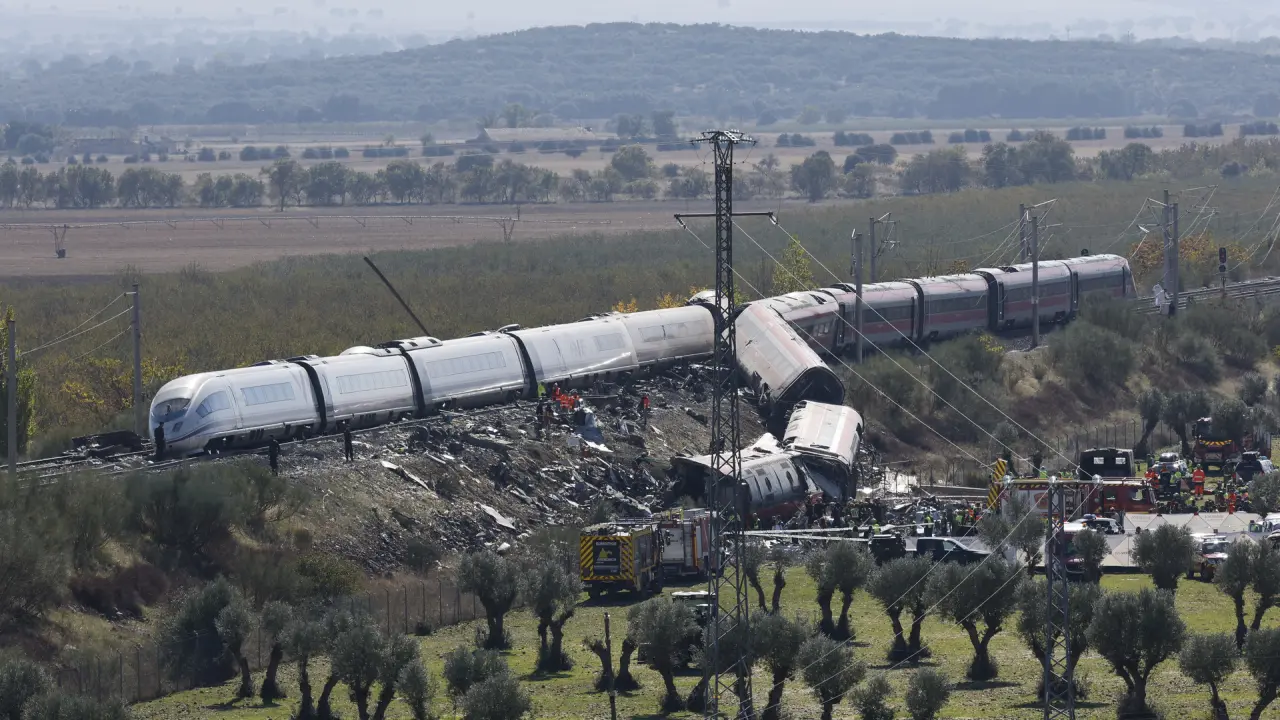
On 28 October 2026 an AVE train from Renfe reached a train from Iryo in the vicinity of Urda (Toledo), in the high-speed line Madrid- Sevilla. The latest data talk about 69 dead and over a hundred injured. When the first emotional impact happens, victims and their families ask themselves very specific questions: who is responding to what happened?, can compensation be claimed?, should we wait for the criminal process to end? This article explains, with legal rigour and without prejudging anyone, how criminal and civil liability work after a railway accident of this magnitude.
2. What is known about the railway accident in Urda
According to the information published so far:
- The AVE 2080 (Madrid- Sevilla) hit the Iryo 6076 train, which was going ahead and was in detention. The impact occurred at an estimated speed of between 160 and 200 km / h.
- By 8: 30, the LZB security system had fallen in the Urda environment and several convoys had been detained. At 8: 36 the Adif control centre in Atocha authorized the AVE to resume the march.
- The Minister of Transport, Óscar Puente, pointed from the first day to a possible human error in the control centre. He later recognized that it is not known precisely what happened in the minutes before the crash. The technical research body has warned that it is premature to set assumptions on the causes.
- Some railway experts and trade unions argue that a number of protection systems failed at the same time, and that the human factor would in any case be a further link to the chain.
- The judicial investigation is conducted by the Court of Appeal of Orgaz (Toledo), which has ordered the secrecy of the case and required recordings and protocols of the Atocha control centre.
It is important to remember that, today, there is no specific cause or any declared responsibility. Everything that follows describes possible legal ways, not conclusions about anyone.
3. Criminal responsibility: which offences are investigated and who can respond
An accident of this kind does not investigate a malicious murder, but a possible murder due to recklessness (art. 142 of the Criminal Code) and Imprudence injuries (Article 152). Generally speaking, murder for serious imprudence is punishable by imprisonment for between one and four years; less serious imprudence is a lower penalty. The difference between the two, and whether or not there is an offence, is a matter to be decided by the courts in the light of the evidence.
Three key ideas on criminal responsibility:
- It's personal and individualized. It is held accountable for its own conduct, not for the office or for membership of an organization. There is no objective criminal liability.
- It can be plural. The responsibility rarely rests with one person. The judges analyze the entire chain: who gave an order, what means and personnel they worked with, what protocols existed, whether automatic security systems worked and whether previous judgements were corrected. A timely human error does not exclude the responsibilities of those who organize, provide or supervise the service.
- It is also answered by omission. A person who has the duty to avoid a result and does not act can respond as if he had caused it (article 11 of the Criminal Code), provided that that duty and the relationship between its omission and damage are confirmed.
Legal persons (companies or agencies) do not, as a general rule, respond for reckless murder, but they can respond in civil terms, as we will see later. And, as in any procedure, it governs the presumption of innocence:: who is summoned as an investigator has the right to defence, to remain silent and to be assisted by counsel. To understand the stages of the procedure you can consult our guide on criminal proceedings in Spain and, if you wonder what rights anyone is called to declare, the article Stop, what now?. You can also see our area of Criminal law.
4. Complaints and appeals: what it means for the case to reach the Supreme Court
According to the press, complaints have already been filed in connection with the accident. One of them, presented by Vox to the Supreme Court, is directed against the Minister of Transport for alleged crimes of murder and injury for serious imprudence, by commission for omission. Others, according to the same information, are directed against Adif's officials.
What does this mean in legal terms?
- A complaint is the act with which the court is asked to investigate facts. To present it does not amount to an admission, evidence or conviction. It is the court that decides whether to admit it to proceedings.
- The members of the Government are ApforatedIf they were to be investigated, it would be the responsibility of the Criminal Chamber of the Supreme Court. If the court investigating the case saw evidence against a person in need, it should raise a reasoned exposure to the Supreme rather than investigate it directly.
- The popular charge (article 125 of the Constitution) allows non-victim organizations or citizens to take the charge. The and members of their families They can also act as a particular accusation, with their own requests.
In short, on a purely legal basis, victims have the right to request that the responsibility of any person, including those in senior management, be investigated if there is evidence to justify this. The success of these requests depends exclusively on the proof.
5. Civil liability: how to claim compensation
It is civil responsibility that economically repairs damage: the death of a family member, injuries, sequelae, psychological damage and expenses. It can be demanded by several means, and are not exclusive:
- In criminal proceedings. By default, civil action is taken together with criminal action (articles 109 et seq. of the Criminal Code): anyone who is convicted must make good the damage. Victims may be involved in the case and claim compensation in the same procedure.
- By independent civilian means. Victims may reserve civil action to claim separately, or directly claim the operator with whom they hired the trip or their insurer.
- Against the transport operator. Buying a ticket means a contract of carriage. Renfe and Iryo respond to their passengers and, under European law, they must pay advances to those who are entitled to compensation within a very short period of time since the beneficiary is identified. There is also compulsory passenger insurance, with its own amounts.
Who is a civil answer:
- The person convictedas a direct responsibility.
- To the insurers, which respond directly to the limits of the policy.
- To the undertakings or bodies for whom the convicted person worked, on a subsidiary basis when the offence is committed in the performance of his or her duties (art. 120.4 of the Criminal Code). This means that, although the error is attributed to a particular worker, the company for which he works may have to respond for the damage.
As regards the amount, the amounts of the compulsory insurance and, as a guidance, the criteria for the traffic traffic traffic are used as a reference in railway accidents (Law 35 / 2015). The compensation is calculated on a case-by-case basis: age, relationship with the deceased, severity of the injuries and sequelae, moral and economic damage.
Attention to deadlines. The civil claim for non-contractual liability generally has a period of one year since the injured person knows the damage, and other different time limits if claimed by contract. The exercise of the action in the criminal proceedings or the proper interruption of the statute of limitations is fundamental. That is why advice should be given soon, even if the criminal procedure is going to last a long time.
6. Financial responsibility of the Administration and aid
Where the damage can be attributed to the functioning of a public service, there is a third way: property responsibility of public administrations (Law 40 / 2015), which is first filed with the administration itself and, if it is refused, with the administrative jurisdiction. The general deadline is one year, with special rules when criminal proceedings are under way.
In addition, following the accident, the Plan of Assistance to Victims of Railway Accidents and their Families (Royal Decree 627 / 2014) was activated, which includes care and information to victims and family members. Following the accidents in Adamuz and Gelida in January 2026, the Government approved a specific aid and advances mechanism; it remains to be seen whether anything similar will be articulated for Urda. Such aid and advances do not replace the final compensation, and the scope of the aid should be known before any document is signed.
7. The questions that research has to answer
Beyond who made a mistake or not, a rigorous investigation must analyze the system as a whole. Some of the questions that our lawyer raised in the video, and which are legally relevant to setting responsibilities, are these:
- How many workers should be in the control centre at that time to provide the service safely? Was that enough?
- Why were the automatic security systems that could have prevented the crash not working or not acting?
- What preventive measures were taken following the Adamuz accident in January this year? Was that enough? If they were adopted, why didn't they avoid this one?
The responses will determine whether there was a single reckless conduct or a chain of omissions, and therefore between those who share criminal and civil responsibility.
8. Real case
In the video, our lawyer reflects from the law school on Urda's accident. He argued that responsibility was not usually exclusive to one person, that all the causes and circumstances must be analysed by listening to the technicians, and that the safety of millions of passengers per year could not be dependent on a single worker. It further points out that victims and their families are entitled to explore any legal means they consider appropriate, including the complaint, against those who may be responsible, subject to the decisions of the courts.
9. Summary: claims
| Via | What is claimed | Against whom | Where |
|---|---|---|---|
| Criminal | Punishment of the crime (murder and reckless injury) | Natural persons with individual responsibility | Orgaz Court of Appeal (and Supreme Court if any) |
| Civil proceedings | Compensation for death, injury and moral damage | Convicted, insured and subsidiary civilian officials | The same criminal case |
| Independent civilian / contract of carriage | Compensation and advances | Operator (Renfe or Iryo) and insurers | Civil jurisdiction or direct claim |
| Property responsibility | Public service performance compensation | Government or responsible public body | Administrative and then administrative claims |
10. What can victims and family now do
- Keep all documentation: ticket, reservation, communications with companies, medical reports, discharge parts, proof of expenses.
- Use official care channels: Renfe provided 900 10 10 20, Iryo 900 00 14 03 and the Orgaz Court of Appeal with a telephone for victims and family members (925 317 020).
- Valuing the personation in the criminal case to have access to the procedure, to propose evidence and to claim compensation. If you've been summoned as a witness, here we explain. What to do when you are summoned as a witness in a trial.
- Review the scope of any offer or document to be asked to sign before accepting it.
- Do not let the deadlines passeven if the criminal procedure is long.
11. Frequently asked questions
Can I claim if I was on any of the trains and I was unharmed?
Yes, if you have suffered damage, including psychological damage, medically accredited. The costs and damages of the accident may also be claimed.
Who can claim a deceased?
The injured: usually a spouse or partner, children, parents and, in some cases, other family members who were dependent on the deceased or had close ties with him. The amount depends on the circumstances of each case.
Should we wait until the criminal proceedings are over to claim?
Not necessarily. It can be claimed within the criminal process, by independent civil means or to the operator and his insurer, but the time limits and strategy must be taken care of to avoid losing rights.
If the mistake was a worker's, does the company also respond?
Yes, the company or body for which he works can be held liable for damage caused in the performance of his duties, whether or not a particular criminal officer is identified.
Can a minister be investigated for a railway accident?
The members of the Government were prepared and would be investigated by the Supreme Court. To that end, the court would have to admit a complaint or receive a reasoned presentation from the investigating court, and there would have to be indications of reckless personal conduct. Until then, it governs the presumption of innocence.
12. Conclusion
After the Urda accident, the victims and their families have the right to know what happened, to have responsibility purified and to be repaired. The criminal and civil channels are complementary, and there is also the legal channels in front of the Administration. The decisive thing now is not to lose rights due to lack of information or time limits, and to let the investigation determine the truth with all the guarantees, including those of those who are investigated. In Leynver Lawyers We study each case to explain clearly what ways there are, who can respond and how to claim.
This article is of an informative nature and does not constitute legal advice. The procedural situation may change as the investigation progresses.
